Lavender during a holiday in Southern France
For many travellers, seeing the lavender fields is one of the reasons to travel to Southern France. Lavender in Provence is an iconic sight that you often encounter during a holiday in France. It is just as characteristic of the region as the markets, the delicious wines, the nature, and the tourist villages. During your tours through Provence, you will undoubtedly come across fields full of lavender.
If you visit Provence at this time of year, you can keep a full day for a route past the lavender fields, villages, markets, and viewpoints. Many tourists choose to combine this with a stay in a holiday home in France. Those who wish to check out multiple regions can take a look at the overview of holiday homes in France.
In this article, you will read when the lavender blooms, where the largest fields are located, and how you can drive along a lavender route during your holiday in Provence. You will also find practical tips for photography, lavender markets, villages, and nature reserves.
Best time of the day to visit lavender fields
Although lavender is beautiful all day long, there are moments when the fields are truly impressive. In the early morning, there is often a soft scent in the air, and the light is warm. For this reason, photographers are often out and about early. In the late afternoon, around sunset, the purple flowers take on a deep hue in the soft light of the low sun. Because it often gets warm in the afternoon, many visitors combine a morning visit with lunch in a village or at a local market.
When does lavender bloom in Provence?
July is generally the best month to visit the lavender fields in Provence. At that time, the fields on the Plateau de Valensole and around Sault are in full bloom and the lavender is a beautiful purple. If it is a warm spring, the lavender may bloom as early as the end of June. At lower temperatures, it may not bloom until the beginning of July. Many photographers and travellers check how far along the lavender is in bloom just before departure. The flowering period also varies by region. The higher the altitude, the later the lavender begins to bloom.
Generally, you can take the following periods into account:
- Mid-June – early July: Luberon and lower-lying parts of Provence
- Late June – mid-July: Plateau de Valensole
- Mid-July – late July: Sault and higher-lying areas
After the bloom, the harvest usually starts. Farmers cut the lavender to make oil from it. As a result, the purple fields slowly disappear. Anyone who wants to see the lavender fields in the South of France, as seen in popular photos, should plan their vacation between the end of June and mid-July.
Lavender calendar by region
To plan your visit well, a simple lavender calendar is handy.
June - The first lavender fields begin to bloom, especially in the Luberon and around Valensole.
Late June – early July - Many fields are in full bloom; this is the best time to take the most beautiful photos of lavender in Provence.
Mid-July - The high-altitude areas, such as around Sault, are now in bloom.
Late July – early August - The harvest begins; the plants are mown for the production of lavender oil.
Keep in mind that the exact flowering time can vary from year to year due to the weather. A warm spring often results in a slightly earlier bloom.
The importance of Lavender for Provence
The lavender fields in Provence are among the most famous landscapes in the South of France. Lavender has been growing in this region for centuries. Originally, the plant was used for its medicinal properties, and the oil was incorporated into ointments, soaps and herbal mixtures.
From the nineteenth century onwards, an entire industry developed around lavender oil. Particularly in the area around Grasse, famous as the heart of perfume production, lavender was used in perfumes and cosmetics. You can read more about this on Grasse Tourism.
Lavender remains an important agricultural product in Provence. The purple fields are beautiful to see every year during a holiday in France. That is why many holidaymakers consciously choose a route past these beautiful fields during their stay in Provence.
Lavender and lavandin: what is the difference
During a visit to Provence, you often hear two names: lavender and lavandin. Although they look alike, they are different plants.
True lavender (lavande fine) - This species grows mainly at higher altitudes, often above 800 meters. The scent is refined and is used for high-quality perfumes and oils.
Lavandin - Lavandin is a hybrid of different lavender species. This plant yields more and grows well at lower altitudes. Lavandin grows in many large lavender fields in Provence.
For visitors, the difference matters little. Both species create the purple landscape that is so characteristic of a holiday in Provence.
The charm of the lavender fields in Provence
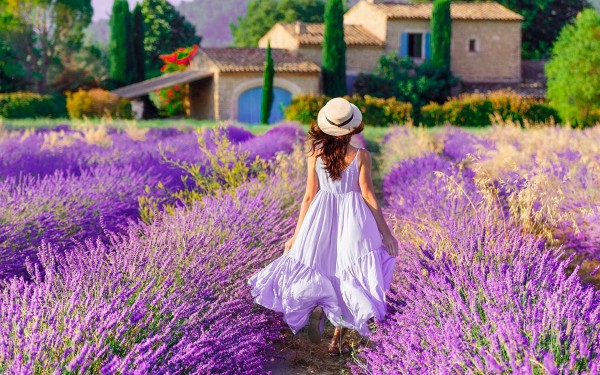
At sunrise, a soft mist lingers over the fields. The scent of lavender spreads through the landscape as bees appear. In the distance, you see the rolling hills of Provence, dotted with small villages whose light-coloured houses stand out. This moment – early in the morning, amidst the lavender – is shared by many visitors as one of the most beautiful moments of their holiday in France.
The most important lavender regions in Provence
The largest lavender regions are located in the department of Alpes-de-Haut-Provence and around Mont Ventoux. The Plateau de Valensole lies north of Manosque, while on the eastern side of Mont Ventoux, you will find the lavender fields near Sault. Further west, in the Luberon, lavender fields lie between villages such as Gordes, Roussillon, and Bonnieux. You can find more information about the landscape and villages in this region on the Mont Ventoux Tourism website.
Plateau de Valensole
Plateau de Valensole lies between Manosque and Moustiers-Sainte-Marie. This is the most famous area with lavender fields in Provence. The plateau, with thousands of hectares filled with lavender and grain, attracts many visitors every summer. The area forms one of the largest lavender fields in Europe. In June and July, you can see the long purple stripes of lavender. The plateau itself is an open landscape, with grain fields, lavender, quiet roads and small distilleries where lavender oil is produced.
Photo spots on the Plateau de Valensole
Early in the morning or around sunset, the colours are often at their most beautiful. The following places are particularly suited for photos:
- Fields along the D6 between Valensole and Riez
- The surroundings of the village of Valensole
- Fields near Puimoisson