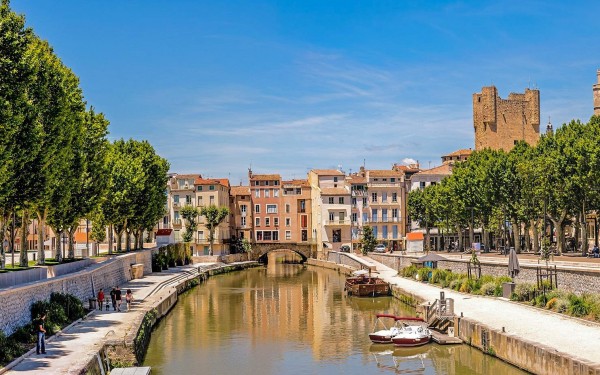
Narbonne is the sort of town you don’t need to fully understand in one go. During a leisurely stroll through the historic centre, along the canal or through the covered market, you’ll get to know the city naturally. The combination of Roman history, vibrant city life and the proximity to the sea and nature makes Narbonne a delightful destination during your holiday in the Languedoc. From your holiday home, it’s an ideal spot for a relaxing day trip, whether on your own or with the whole family.
The city is easily accessible and offers plenty of variety for both adults and children. Anyone staying in a comfortable holiday home in the Languedoc-Roussillon during a holiday in the South of France, will soon discover that Narbonne is centrally located in relation to beaches, vineyards and other attractions in the South of France.
Narbonne in the Languedoc: culture, beaches and a relaxed city life
What kind of city is Narbonne?
Narbonne is often mentioned in the same breath as larger cities in the area, such as Montpellier and the famous Carcassonne. Whilst Carcassonne is renowned for its impressive fortifications and Montpellier has a modern feel, Narbonne offers a lovely balance. This city exudes everyday French life and boasts a harmonious blend of culture, shopping and relaxation. With a compact and largely flat city layout, Narbonne is ideal for exploring by foot. This is a major plus for families and for anyone who wants to stroll through the city at a leisurely pace. A visit to Narbonne from your holiday home with air conditioning fits in perfectly with a holiday in which comfort and experience are central.
Places of interest in Narbonne
In the heart of Narbonne stands the impressive Cathédrale Saint-Just-et-Saint-Pasteur. This Gothic cathedral is one of the tallest in the south of France. With her enormous dimensions and the beautiful light that falls through the windows, she immediately makes a big impression. The construction of this cathedral started as early as the thirteenth century, but strangely enough it was never completely finished. This unfinished aspect adds to its unique charm.
Right next to the cathedral is the Palais des Archevêques, the former bishop's palace. This imposing building exhibits a variety of architectural styles and is home to a number of museums and exhibitions. If you climb the tower, you’ll be rewarded with a magnificent view over the rooftops of Narbonne and the vast plains stretching towards the sea and the vineyards.
The cathedral and the palace together form the historic center of the city, and the square surrounding them is the perfect spot to take a breather during your walk.
Roman history: tangible and accessible
From holiday park Espinet you can also go to Narbonne for a day if you are interested in the history of the South of France. Narbonne was founded in 118 BC as a Roman colony and was an important port city for centuries. The Via Domitia, one of the oldest Roman roads in France, ran right through the city and connected Italy with Spain.
A remarkable remnant from that period is the Horreum Romain, a network of underground passages and storage areas. This is one of the few Roman buildings in Narbonne that has remained virtually intact. The Horreum is a great place to visit, even for children.
For those wishing to learn more about the Roman history of the South of France, a wealth of information can be found on the official French tourism site france.fr.
A stroll along the Canal de la Robine
The Canal de la Robine flows right through Narbonne and connects to the Canal du Midi, which is on the UNESCO World Heritage List. Along the canal, you’ll find charming quays, bridges and inviting terraces. It’s a lovely spot to relax, especially on warm days.
The canal forms a natural thread through the city, linking the historic centre with newer neighbourhoods. The atmosphere here is particularly pleasant in the morning and late afternoon.
Les Halles: Narbonne’s covered market
The covered market Les Halles de Narbonne is one of the most popular places in the city. Locals and visitors alike head here to do their shopping, have lunch or simply browse. You’ll find fresh fish, meat, cheese, vegetables and local produce.
Visit Les Halles and discover what this market in the Languedoc has to offer. A visit to the market is often an integral part of the holiday experience in the South of France.
What is there to do in Narbonne?
A leisurely stroll through the city
Narbonne is ideal for a leisurely stroll without having to stick to a set route. The town centre is easy to navigate, and you’ll naturally pass by various shops, squares and interesting spots. This makes the town perfect for anyone who wants to combine culture with a bit of relaxation.
Shopping and terraces
In Narbonne, you’ll find charming boutiques alongside popular high-street chains. Most of the shopping area is located around Rue Jean Jaurès, a wide and lively street lined of fashion shops and cozy cafes. In the atmospheric Rue de l'Ancien Courrier and Rue Droite, near the cathedral, you will discover smaller specialty shops, local stores and artisan boutiques that are certainly worth a visit. For a moment of relaxation on a terrace, the Cours Mirabeau, along the canal, is a favourite spot among visitors.
Narbonne with children
Narbonne isn’t a city packed with attractions, but that’s precisely what makes it so lovely for families. Distances are short, the city centre is largely traffic-free, and there are plenty of places to take a break. The Horreum Romain and the canal are interesting spots that invite exploration and offer a bit of variety. Many families choose to combine their visit to the town with an afternoon at the beach of Narbonne-Plage. This fits in perfectly with a holiday on the Mediterranean Sea.
Narbonne by season: when is the best time to visit the city?
Narbonne is a great place to visit all year round, but each season has its own unique charm.
Spring (April – June)
Mild temperatures, blooming nature and less crowds. Ideal for hiking and culture.
Summer (July – August)
Lively and warm. It’s best to visit Narbonne in the morning and spend the afternoon at the beach.
Autumn (September – October)
A quieter time, with pleasant temperatures and the grape harvest in the region. A popular time for couples.
Practical tips for your visit to Narbonne
FranceComfort is happy to give you travel advice for your visit to Narbonne from your holiday home in France. The best option for parking is in a multi-storey car park just outside the city centre. From there, it’s a short walk into the city. Due to environmental regulations, an environmental sticker (Crit'Air) is mandatory in some cities and specific environmental zones apply. Those travelling via the motorway can save time by familiarising themselves with information on toll roads, toll badges and flux libre. It is also advisable to familiarize yourself in advance with the applicable laws and regulations in France .
Local cuisine and gastronomy
Narbonne’s cuisine is typical of the Languedoc: hearty, authentic and based on local produce. Cassoulet is a classic, but fish dishes and Mediterranean meals also feature prominently. At the market, you’ll find olives, tapenades, cheeses and sausages that are typical of the South of France.
You can find more information on regional dishes and wines from the Languedoc-Roussillon via FranceComfort.
Walking in nature
The area around Narbonne is home to beautiful flora and fauna. If you have some spare time, why not go for a walk in one of the nature reserves?

Five well-known restaurants in Narbonne
- Les Grands Buffets- Here you can enjoy a comprehensive introduction to classic French cuisine, with plenty of choice and a set price. The restaurant’s layout also makes it ideal for families.
- La Table de Nicolas - A restaurant for those who wish to enjoy Languedoc cuisine in a relaxed atmosphere.
- Chez Bebelle- Located in Les Halles and loved for its informal atmosphere. It’s the perfect choice for lunch whilst visiting the market, offering simple yet delicious food.
- Le Petit Comptoir - A cosy bistro with a menu that changes regularly. Perfect for a relaxed dinner after a day spent strolling through the city centre.
- L'Estagnol - Known for traditional dishes and a warm welcome. A great place to sample the regional cuisine.
What is Narbonne known for?
Narbonne is renowned for its rich Roman history, lively markets and close ties to wine production. The city acts as a bridge between the sea, the vast vineyards and the surrounding nature reserves. That is why Narbonne is not only a city worth visiting, but also an excellent base for exploring the region.
Popular combinations include a visit to Carcassonne or Perpignan, both of which are within easy reach.
Combining Narbonne with other trips
At FranceComfort, we’ve noticed that many guests combine a visit to Narbonne with other trips in the region. Why not spend a day at one of the nearby seaside resorts? Looking for something more active? Then try your hand at water sports or plan another sports activity. Nature, culture and history enthusiasts will also find plenty to enjoy in this region. he following day, you could visit the French Pyrenees.
Events and holidays
Narbonne is particularly lively during national holidays, such as Quatorze Juillet. Finding out more about public holidays in France will help you plan your visit.
Narbonne and holidays with FranceComfort
Narbonne is the perfect choice for a holiday in the South of France, offering both comfort and freedom. Whether you opt for the Languedoc, a holiday in the Dordogne, a holiday in Provence or a holiday in the Poitou-Charentes, FranceComfort offers comfortable accommodation across several regions.
Anyone dreaming of a place of their own under the French sun might want to look into the possibility of buying a holiday home in France.
Frequently asked questions about Narbonne
1. Is Narbonne a good place to visit with children?
Yes, because it’s easy to get around and offers a mix of city and beach.
2. How much time do you need for Narbonne?
One day is enough; combining it with a trip to the beach makes for a more varied experience.
3. What is the best day to visit Narbonne?
It’s quieter during the week, whilst market days are lively.
4. Can you combine a visit to Narbonne with a trip to the beach?
Yes, Narbonne-Plage is just a short distance from here.
5. Is Narbonne suitable as a day trip from a holiday home?
Definitely, Narbonne is centrally located and easily accessible..
Discover our holiday homes in Languedoc and plan your next holiday in France
Narbonne showcases the diversity of a holiday in the Languedoc like no other. Culture and history, bustling markets, delicious food and the proximity of both the sea and nature come together here quite naturally. Whether you opt for a relaxing day strolling through the town centre, enjoying lunch at the market, or wish to combine a visit with the beach and the beautiful surroundings, Narbonne is a destination that will undoubtedly enrich your stay in the South of France. Would you like to explore this city and the surrounding region at your own pace, from the comfort of an accommodation at one of the FranceComfort Holiday Parks? Choose a holiday home or a holiday park in the Languedoc, where peace, space and quality come first. Take a look at FranceComfort's range of holiday homes. This way, you’ll get the most out of the region and enjoy the comfort of a lovely holiday destination.
Our parks in the Languedoc Our homes in the Languedoc Order an Environmental sticker Order a Toll badge