Cathars in the South of France

Castles, landscapes and history during your holiday

This page provides an overview of the Cathars in the South of France. You can read who the Cathars were, why this region became the centre of their world and which castles, ruins and villages you can still visit today. The text has been written for holidaymakers who wish to gain a deeper understanding of the landscape they are travelling through during their stay. 

A landscape that shows its past

During a holiday in the South of France, you’ll soon notice just how strongly the past is felt here. The roads wind naturally through the valleys and along the rivers. The villages are often situated on ridges or built against steep rock faces. And high above you, you can see the walls and towers rising up; some are still intact, whilst others are nothing more than a few stones revealing the outlines of days gone by.
These locations were not chosen at random; they form part of a landscape that for centuries served as a line of defence, a refuge and a seat of power. When you travel here, you find yourself in the former heartland of the Cathars. During your holiday in France, this heritage is not a separate adventure, but rather a silent companion that accompanies you on almost every journey.

Who were the Cathars?

The Cathars called themselves bons hommes en bonnes femmes. They were Christians, but rejected the wealth and hierarchy of the Roman Catholic Church. Their faith was simple and centred around personal conviction. Priests, splendour and the power of the church were of no importance to their religious practice.
This way of life fitted perfectly with the culture of southern France in the 12th and 13th centuries. At that time, the region had a strong local nobility, its own language (Occitan) and a relatively independent society. Historical analyses, such as those of Encyclopaedia Britannica on Catharism, show that this was not a marginal movement, but a deeply rooted social phenomenon. 

Occitania and the Aude: the heart of the Cathar region

The Cathar heartland was located in historic Occitania, which roughly encompasses the present-day Languedoc, along with parts of the Pyrenees and, in particular, the Aude department. Cities such as Toulouse, Albi and Carcassonne offered protection, whilst the surrounding countryside served as a refuge.
If you choose to stay in this region today, for example when on holiday in the Languedoc, you will find that the landscape still has a profound influence. Distances are manageable, but the roads encourage a leisurely pace. It was no different in the Middle Ages.

The crusade against the Cathars

In 1209, Pope Innocent III called for a crusade against the Cathars. Although it was officially intended as a means of religious purification, power and expansion of territory were in reality key motivators. The French crown seized upon this crusade to bring the independent south under its direct control. Cities were besieged, villages destroyed and the land expropriated. According to the French Ministry of Culture, which recognizes the Pays Cathare as a historical heritage area, this period has had a lasting impact on the political and cultural structure of southern France.
Anyone travelling through this region today will pass places that still bear the scars of this conflict.

Montségur: last refuge and symbol

No place is as strongly linked to the Cathars as Château de Montségur. This imposing fortress stands on a steep limestone cliff at the foot of the Pyrenees. In 1243, Montségur was besieged by a large royal army, whilst several hundred Cathars and their followers were inside.
After a siege lasting almost a year, they finally surrendered. However, around 220 men and women refused to renounce their faith and paid the ultimate price; they were burned at the stake at the foot of the mountain. The Centre des Monuments Nationaux considers Montségur to be one of the most symbolic sites of medieval France.
Anyone making the climb today will notice just how remote this location is. The walk is short, but the slopes are steep. At the top of the mountain, a strong wind often blows and the view is breathtaking. At the foot of the mountain, a simple stèle commemorates the victims of this dark period. Many visitors linger here longer than they had intended, overwhelmed by the history that this place carries with it.

Myths, treasures and solstices

After the fall of Montségur in 1244, the story of the Cathars continued to live on, mainly in the form of legends. The violent end of the castle led to facts and fantasy becoming intertwined.
A well-known story is that of the Cathar treasure. According to tradition, shortly before the surrender, a few Cathars are said to have hidden valuable objects, documents or symbolic knowledge in a safe place. Exactly what this treasure might have been remains unclear. There is talk of gold, relics or secret texts. Historians point out that there are no reliable sources to substantiate this, but the idea continued to circulate in the region for centuries.
 
Montségur also acquired a spiritual significance. Its remote location on a high rock, with an unobstructed view of the surrounding area, contributed to the image of this special place. In the 20th century, a theory emerged that the castle had been deliberately aligned with astronomical phenomena, particularly the solstices. During the summer solstice, sunlight falls in a remarkable way through certain parts of the ruins. The light moves along walls and openings and disappears on the other side. Archaeologists emphasise that medieval builders primarily took defence and the terrain into account, but they acknowledge that this play of light and shadow has a striking effect, particularly in the early morning.
These stories explain why Montségur continues to fascinate to this day. Here, you are not simply visiting a ruin, but a place where history, landscape and imagination converge. 

Visiting Cathar castles as a day trip during your holiday

The castles are relatively close to each other, but the roads between them are winding. Therefore, don't try to pack too much into a single day. Combining two locations gives you enough time to enjoy the scenery as well. There are often excellent opportunities for walking or cycling near a castle.
Many locations are easily accessible from places such as Quillan or Limoux. Those staying here can explore the area further through information on sporting activities in the Languedoc, culture and history, the Pyrenees in France and an overview of fortresses and castles.

Cathar castles you can visit today

Montségur is not alone; it is part of a larger whole. Across the Aude and the neighbouring regions of the Pyrenees lie various castles and ruins that have played a part in the story of the Cathars, both directly and indirectly. Together, they form a network of strategic locations, often built on hard-to-reach rocks overlooking valleys and passes.
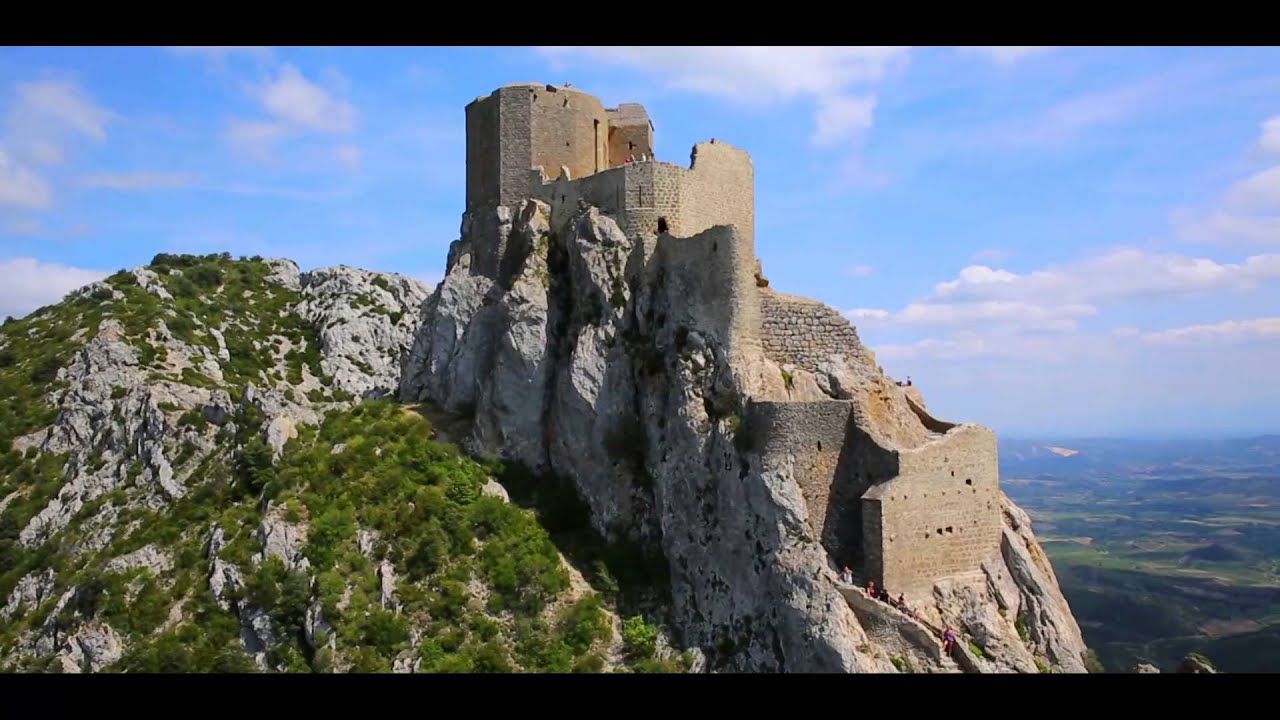
Take, for example, Château de Quéribus, which stands on a narrow limestone rock in the Corbières. The climb to the top is short but steep, and once up there you have a breathtaking view as far as the Mediterranean Sea in clear weather. The location immediately shows why this castle has been able to last so long. Château de Puilaurens is more sheltered, surrounded by dense forests. This castle exudes a calmer feeling and is particular pleasant on warm days. Château de Roquefixade has been less extensively restored and therefore has a rougher character. Here you get a good sense of just how exposed these places once were.

There are also lesser-known castles that are definitely worth a visit.
Château d'Usson is somewhat remote and therefore attracts fewer visitors, which adds to its charm. Château de Peyrepertuse stretches along a mountain ridge and impresses with its size and appearance. Château de Lastours, a complex comprising several interconnected castles, also demonstrates just how important this region was as a defensive stronghold.

The Cité de Carcassonne offers a different perspective. This fully walled fortified city shows how strategically important this region was to the French crown, especially after the Crusades. The city is a UNESCO World Heritage Site and makes for a perfect complement to a visit to the more remote castles. Practical information can be found at Carcassonne.

Rennes-le-Château is also frequently mentioned in connection with the Cathars. This small village has gained an almost mythical status through stories of hidden knowledge, treasures and secret documents. For more background information, please visit Rennes-le-Château. Together, these locations provide a comprehensive picture of the Cathar landscape. Not every castle was actually a Cathar stronghold, but they all form part of the same historical network. From your air-conditioned holiday home in the Languedoc,  you can visit them individually or combine them in leisurely day trips, where the beautiful landscape is just as important as the historic stones themselves.

Katharen 14 overzichtskaart kastelen in de Aude en Ariege.jpg

Tip – A route based on personal experience

Many visitors combine several Cathar sites over one or two leisurely days. The park manager at L'Espinet in the Quillan region described his favourite route as follows:

“In the morning, I drive from Quillan towards Puilaurens. The road is narrow but quiet, and you can see the landscape gradually opening up. I then continue on to Montségur. Up there, it’s often quite windy, even on warm days. What strikes me every time is the silence as soon as you’re back down. On the way back, I like to stop in a small village for a coffee. You’re out and about all day, but you don’t feel any rush.”

This route can easily be combined with a stay in the Quillan area and gives you the chance to really experience the countryside.

Practical considerations

Most castles are situated on higher ground. It is therefore advisable to wear sturdy hiking boots. In summer, it can get quite hot and there is often little shade to be found. So do bring some water with you. It is best to visit the castles early in the morning or later in the afternoon. Facilities at the castles are usually limited. Combine your visit with lunch in a nearby village or a picnic en route. 

The Cathars and your stay in the South of France

The rich heritage of the Cathars goes hand in hand with a peaceful and comfortable base. Many people deliberately choose to stay inland so that they can set off on explorations during the day and return in the evening to the peace and space of their accommodation.
If you are looking for somewhere to stay, a holiday home in France could be just the thing, as could a look at our range of our holiday homes. By exploring the different regions, you can more easily choose a location that suits you. For this specific area, a holiday home in Languedoc-Roussillon is  an obvious choice.

Frequently asked questions

1. What are Cathar castles?
They are fortresses and fortified places that played a role during the persecution of the Cathars, serving both as places of refuge and as instruments of power.

2. How much time should you plan for your visit to Montségur?
Allow one and a half to two hours, including the walk and time spent at the ruins and memorial site.

3. Are the castles suitable for children?
They are suitable for older children who are good walkers. The climb and the height make some locations less suitable for young children.

4. Which castles are located in the Aude?
Quéribus, Puilaurens and Carcassonne are located in the Aude. Montségur is just in Ariège, but is often visited as part of a combined trip.

5. Can you visit several castles in one day?
It is possible, but two locations per day is usually sufficient to keep things relaxed.

Book your holiday to the South of France

The Cathars are not merely a closed chapter in a history book. Their story is visible in the landscape, in the layout of the villages and in the silence surrounding the ruins. During your holiday in the South of France, this heritage gives meaning to the surroundings you find yourself in. Would you like to experience the region of Cathar castles for yourself and combine it with nature, tranquillity and comfort? Then take a look at the options for a stay in the South of France and choose a holiday home that suits your style of travel. In this way, history becomes not just a separate excursion, but a natural part of your holiday.

Our parks in Languedoc     Our parks in the Dordogne

Back to the overview