




The 2 large areas of France on the Mediterranean Sea are the Provence - Côte d’Azur in the southeast and the Languedoc - Roussillon in the south.
The Languedoc - Roussillon is the merger of the old French provinces of Languedoc and Roussillon and comprises 5 departments from North to South: Lozère, Gard, Herault, Aude and Pyrénées-Orientalis. At the beginning of 2016, the Languedoc - Roussillon region was merged with the Midi-Pyrénées region to form Occitanie. During a holiday in the South of France, many holidaymakers book a holiday home near the Pyrenees.
The Languedoc is known as a region that is very popular with tourists. The landscape is varied: the mountains of the Pyrenees, the vast sandy beaches of the Mediterranean, vineyards with quality wines. But the history and culture is also clearly visible here. In this region, you may need a France “Crit’Air” environment sticker. There is a possibility that you will drive through a permanent or temporary environmental zone. Keep this in mind when driving to your holiday home in the Languedoc.
- Pyrénées-Orientalis - This department is the southernmost department of the original Languedoc-Roussillon. The southern part of this department lies in the Pyrenees and borders Spain, the eastern part lies on the coast of the Mediterranean Sea. Perpignan is the capital
- Aude - To the north of the Pyrénées-Orientales is the Aude department, named after the river that flows through it. Carcassonne is the capital
- Herault - The Herault is located a little more to the north, with Montpellier as its capital
- Gard - The Gard is located between the Herault and Provence. Nimes is the capital of this department
- Lozère - This is the only department of the Languedoc that is not on the coast. It is located northwest of the Gard and has Mende as its capital
Landscape of the Languedoc
The landscape is structured in the same way in almost all departments. On the coast are the wide and kilometers of sandy beaches. These are interspersed with authentic fishing ports and modern seaside resorts. Behind the sandy beaches there is a varied hilly landscape with rolling slopes, often with vineyards. This hilly terrain is the foothill of the Pyrenees in the southern departments and of the Montaigne Noir and Cévennes in the northern departments of the Languedoc. The Montaigne Noir is a mountain range that runs parallel to the Pyrenees but is a little more to the north. Between these two mountain ranges, the motorway runs from Toulouse to Narbonne on the coast. Halfway is the city of Carcassonne with its characteristic castle "La Cité". There are picturesque French villages scattered throughout the landscape, interspersed with a somewhat larger city. Here you can enjoy the various regional dishes. Be sure to visit the villages of Mirepoix and Rennes-le-Château; they are well worth seeing.
Sights in the Languedoc
The Languedoc is an area with many attractions. Some highlights are the following:
- Cité de Carcassonne - This medieval castle is world famous and attracts many tourists every year. This historic city, which is still partially inhabited, is on the UNESCO World Heritage List
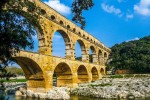
- Pont du Gard - It is one of the most famous photographs of France: the Pont du Gard, northeast of Nimes. This structure is the best preserved aqueduct in the world
- Canal du Midi - This is the oldest canal in Europe that is still in operation and connects the Atlantic with the Mediterranean. UNESCO has included it on the World Heritage List. At the time this channel was made, it was a major architectural achievement. The height differences are large and therefore many locks have been installed
- Amphitheater of Nimes - This amphitheater was built in the first century of our era. It looks exactly like the theater of Arles and both are built after the example of the Colosseum in Rome
- Causses and Cévennes - The beautiful natural area of Causses and Cévennes is also on the UNESCO World Heritage List. They are the foothills of the Massif Central and are located in the northern part of the Languedoc
- Forts of Vauban - The builder Vauban has been a household name in France. This man designed forts and other defenses that were able to stop the enemy. In the Languedoc, 2 buildings are his: the fortified town of Villefranch-de-Conflent and the Mont-Louis castle in the Pyrenees
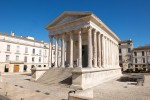
- Maison Carrée - One of the best preserved Roman temples is in Nimes. This building can be visited. The architectural details that were important at that time are clearly visible
Aude region
The Aude department, where the L’Espinet holiday park is located, is surrounded by a number of departments. In the south the Pyrénées Orientalis and the Ariège. In the west Haute-Garonne (with Toulouse as the capital) and in the north the Tarn and the Herault. The eastern part of the Aude lies on the Mediterranean Sea.
The Aude, with Carcassonne as its capital, is known as the region of the Cathars, original inhabitants who built many fortresses and castles. The most famous castle is the Cité of Carcassonne.
In the Aude are several places that are more than worth a visit: Carcassonne, Narbonne, Limoux, Gruissan and Quillan. There are also many places of interest in the department such as:
- Abbey of Sainte-Marie de Lagrasse, Fontfroide, Saint Papoul and Saint Hilaire
- The Canal du Midi, the famous channel from west to east with its many locks
- Châteaux Puivert, Lastours, Quéribus, Peyrepertuse, Peylaurens
- Gouffre de Cabrespine
- Grotte de Limousis and l'Aguzou
- Gorges de Gouleyrous, the Padern, the Pierre Lys, du Torgan
Vineyards and wines
There are several regions in France with vineyards. The largest wine region in France is Languedoc-Roussillon. The viticulture in this region is 2000 years old. This area became less known after the fall of the Roman Empire. Wine was only grown for local consumption. This has changed since the 17th. Later, in the 19th century, Languedoc was the largest wine region in the world. However, the quality of the wine was poor. In the seventies and eighties of the 20th century the emphasis shifted to the quality of the wine.
The flat coastal region of Languedoc-Roussillon has a pleasant Mediterranean climate and is ideal for wine grapes. Most of the vineyards in Languedoc-Roussillon are therefore in the flat coastal area. Grapes are also planted at the foot of the Pyrenees. The grapes develop full and juicy aromas through the warm and dry summers.
There are various wine regions, the largest being the following:
- In the southernmost region, just above the Pyrenees is a large area with "Côtes-du-Roussillon"
- On the coast at Collioure and Banyuls, the "Collioure wines" and "Banyuls wines" are produced
- The Fitou and Corbières wines are grown between Perpignan and Narbonne
- More inland around Limoux is the sparkling wine “Blanquette de Limoux”
- North of Narbonne it is mainly the Minervois wines and the Coteaux du Languedoc
Mediterranean
The coast of the Languedoc is approximately 200 km long. There is a varied nature: sandy beaches, beaches with pebbles, rocks and nature reserves. There are almost 30 seaside resorts along the Languedoc coast.
In the southernmost part of the Languedoc, against the Spanish border, lie beautiful bays between Collioure and Cerbère. Large parts are protected nature reserves. There are no noisy jet skis, large beach bars or rows of sun loungers. The bays at Banyuls and Port Vendres are beautiful. The wide sandy beaches lie to the north of this nature reserve. The southernmost beach is at Argelès-sur-Mer and Argelès Plage. Further north are famous seaside resorts such as Saint Cyprien, Canet Plage, Leucate, Valras and Cap d'Agde.
A lot of entertainment is possible on the beach and in the water. Jet skis are rented out at various locations or a boat trip can be made. Kite surfing is also fully done. Playgrounds for children are often made on the beach and cozy beach tents are set up. From the beach it is often possible to walk into a village, stroll along the shops or sit on a terrace.
Sports and leisure
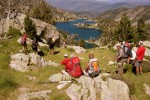
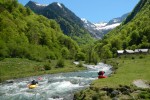
The Languedoc-Roussillon offers the sporting tourist many options. You can take beautiful walks in the Pyrenees or bike rides through the vineyards. Hiking, rafting, mountain biking, abseiling and canoeing excursions are also organized in the Pyrenees. Lovers of (wild) nature can enjoy the varied landscape and the beautiful panoramas in the nature parks here. The Tour de France regularly passes through this region.
Along the coast you can dive, water sports or relax on the beach. There are also plenty of cycle paths in the coastal region and the more experienced cyclist can go cycling in the Pyrenees. Various tours have been set out for beginners and more advanced.
Hiking and cycling in the South of France: what makes the Languedoc different?
Walking and cycling in the Languedoc feels different to any other regions. The landscape is diverse with a drier climate making way for spectacular views and vast areas to explore in-between destinations. Whether its flat terrain like cycling in the Dordogne or adventurous mountain biking along the Lot Valley, you encounter numerous trails with rivers and villages to explore. Walking in the Dordogne is greener and more sheltered. To the south, you can walk in the Var and cycle in Provence where the routes are often steep and rugged. If you prefer a less strenuous experience, we recommend hiking in the Poitou-Charentes or cycling on the Atlantic coast. But if you really want to go into the mountains, you will immediately notice the difference in the Alps. There, routes around hiking in the French Alps and cycling in the Portes du Soleil are shorter, but a lot more intensive. In the Languedoc, it's less about the undulation and more about space. You can decide how far and wide or how near and focused you want your visit to be.
Pyrenees
The southernmost part of the Languedoc is in the Pyrenees. This mountain range has been the border between France and Spain for centuries. The Pyrenees stretch from the Atlantic coast in the west to the Mediterranean sea in the east. The highest peak is slightly higher than 3400 meters. Between Spain and France, in the eastern part of the Pyrenees, lies the small state of Andorra, known for its tax regime.
The Pyrenees is a popular area for tourists, although mass tourism like the Alps is not there yet. That is why there are plenty of authentic villages in the Pyrenees. Take a trip through the valleys and over gorges on the famous "Train jaune". There are also many nature reserves. In the winter there are ski areas.
The Pyrenees are also known from the Second World War. The so-called England sailors traveled from France through the Pyrenees to Spain and then to England.
Castles and fortresses
There are many fortresses and castles in Languedoc-Roussillon. Most are located in the Aude department in the Les Corbières region. They usually stand on steep, remote hills, perfect places where the enemy could hardly reach. They were places where the Cathars were safe. The Cathars formed a religious minority that was oppressed by the Roman church. They were fought in the early Middle Ages and where possible massacred.
The remains of various castles and fortresses are clearly visible:
| Château Comtal | Château Quillan | Château Puivert | Château Villerouge |
| Château de Castries | Château Montségur | Château d’Aquillar | Château de la Mogère |
| Château de Peyrepertuse | Château Roque Fixade | Château de Termes | Château de Flaugerges |
| Château de Quéribus | Château de Montaillou |