Pétanque in France: why jeu de boules is so popular during your holiday in France

Pétanque, also known as jeu de boules, is a typically French sport in which players throw metal balls as close as possible to a small wooden target ball. Especially during a holiday in France pétanque is part of daily life on village squares, café terraces and holiday parks in regions such as Provence, the Dordogne and the Languedoc.
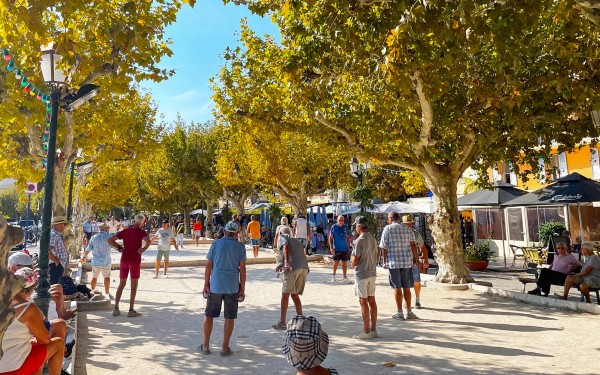
Anyone driving through a village from one of the FranceComfort holiday homes will see it happening: a group of people beneath the plane trees on a village square, a small wooden ball on the ground and metal boules being thrown with great precision. From a nearby terrace comes the clink of pastis glasses; someone argues passionately about which ball is closest to the jack, while tourists look on curiously from the edge of the square. This is France at its very best: relaxed, sociable and full of atmosphere.

Pétanque, or jeu de boules as many call it, is far more than a sport. It is part of French culture, the holiday feeling of the South of France that so many people return to year after year. Whether you are staying in a luxury holiday park, visiting a charming village or relaxing in a comfortable holiday home in France : chances are you will come across a pétanque court somewhere along the way.
For many holidaymakers, pétanque has become as much a part of France as markets, long outdoor dinners, lavender fields and medieval villages. On warm summer evenings you can often hear the familiar sound of metal boules clinking together on the gravel from a distance. That sound, combined with people chatting on the terrace and crickets in the background, is for many visitors the very essence of France. 

What is the difference between pétanque and jeu de boules?

Many people use the words pétanque and jeu de boules interchangeably, but officially there is a difference. Jeu de boules is actually an umbrella term for various French ball games in which metal balls are thrown towards a small wooden target ball. Pétanque is the best-known of these.
In pétanque, the player must stand still while throwing. Both feet remain within a small circle on the ground. This is precisely what sets pétanque apart from older forms of jeu de boules, in which players were still allowed to take a run-up. The word pétanque comes from the Provençal “pieds tanqués”, which literally means: feet planted firmly on the ground.

In practice, most people today mean pétanque when they talk about jeu de boules. On holiday parks, village squares and campsites throughout France, this is almost always the version played — certainly in southern French towns such as Antibes, Cannes, Èze or Cassis.
Alongside pétanque, other variants of jeu de boules exist, such as jeu provençal and boule lyonnaise. In Italy, bocce is popular. Even so, pétanque remains by far the best-known and most widely played version in France. 

Our homes in France     Our offers

Why pétanque is so strongly associated with France

Pétanque has grown into a cultural symbol of France. The game is not just about winning — it is above all about being outside together, talking, laughing and enjoying the moment.
That fits perfectly with the French way of life. At holiday parks such as Domaine de Castellane, it is played enthusiastically. In many French villages, the square forms the social heart of the community. People meet there at the end of the afternoon for a drink, a chat and a few rounds of pétanque. In the South of France this is often accompanied by a glass of pastis, the anise-flavoured drink that for many French people is inseparably linked to long summer evenings and pétanque on the village square. Around six o’clock, many French villages slowly begin to come alive. Terraces fill up, chairs are moved outside and the first players appear on the square with their metal boules tucked under their arms. As the temperature slowly drops, the first game of the evening gets underway.

Especially in the South of France, that daily rhythm is still very much in evidence. During a stay at Vallée Ste. Baume, you soon notice how unhurried life is here. Markets last longer, dinners start later and people take their time over social moments. Pétanque fits perfectly into that atmosphere. 

Pétanque as a social part of French life

The game brings generations together. Children play alongside parents and grandparents, experienced players explain the rules to curious tourists, and at holiday parks such as Jardin du Golf, small spontaneous tournaments spring up between guests.
Although pétanque is often seen as a traditional sport for older generations, more and more young people are rediscovering it. Particularly through social media and summer tournaments, its popularity among younger audiences is growing.
This means pétanque remains not only a tradition, but also a thoroughly modern social activity. That is precisely why so many holidaymakers enjoy it,  it is accessible, sociable and thoroughly French. 

The origins of pétanque in the South of France

Ball games existed among the ancient Greeks and Romans. Over the centuries, various forms of jeu de boules remained popular throughout southern Europe, particularly in the South of France where pétanque eventually became the best-known variant. Although ball games have existed for thousands of years, the modern form of pétanque only emerged at the beginning of the twentieth century.

The current version of the game was devised in 1907 in La Ciotat, near Marseille on the Mediterranean Sea. A local player, Jules Lenoir, suffered from rheumatism and was no longer able to take a run-up during the game. The rules were therefore adapted so that players could throw from a stationary position within a circle. This new variant proved enormously popular. From the Provence and villages such as Sanary-sur-Mer, Bormes-les-Mimosas and Saint-Tropez the game spread rapidly across France.

The Provence is still regarded as the heartland of pétanque culture. During a holiday in the Provence you will see people playing almost everywhere: on village squares, beside cafés and beneath great plane trees that provide welcome shade on warm summer days.
Pétanque has since grown into an international sport with millions of players worldwide, yet France remains its centre, with major national competitions, professional players and international championships.

Pétanque in the Provence: the heart of the South of France

Pétanque on village squares and café terraces

Many people immediately associate pétanque with Provence. That is hardly surprising. This is precisely where everything comes together that so many holidaymakers look for during a holiday in the South of France: ancient villages, terraces, markets, long summer evenings and relaxed conviviality. For more inspiration about the region, visit the official tourism website of Provence-Alpes-Côte d’Azur. From small Provençal villages to larger towns around Marseille and Aix-en-Provence: pétanque courts are everywhere. Sometimes they are official boulodrome facilities; sometimes just a patch of gravel beside a terrace. In inland villages such as Saint-Paul-de-Vence, Tourtour or Cotignac the atmosphere is wonderfully relaxed. 
During a stay in a holiday home in the Provence you will quickly notice that pétanque is part of daily life. In the mornings it is often older residents who play, while in the evenings whole families gather on the square.

Markets, villages and families with children

Many holidaymakers combine an evening of pétanque with a visit to the vibrant markets in the Provence: first browsing stalls piled high with olives, herbs and lavender products, then dinner on the terrace, and finally a
relaxed game of jeu de boules beneath the plane trees.
The market of Castellane is one of the best-known markets in the region and is popular with visitors exploring the Provence. The town of Castellane lies close to the famous Lac de Castillon.
The Provence is also renowned for its atmospheric villages where pétanque is still very much part of local life. Travelling through the most beautiful villages on the Mediterranean coast you will regularly come across small tournaments on the village square. Around the Gorges du Verdon there are many beautiful villages to explore. If you pass through Salernes, do stop and wander through the town market and watch the pétanque matches that take place later in the day. Families will discover just how wonderful this family-friendly region is. Pétanque is an ideal activity for young and old to enjoy together outdoors. 

Jeu de boules in the Dordogne

Pétanque among markets and village squares

During a holiday in the Dordogne pétanque fits perfectly with the combination of peace, nature, markets and atmospheric villages. In villages along the Dordogne river, locals gather in the evening on small squares or beside cafés to play a few rounds. Especially on warm summer evenings, a wonderfully relaxed atmosphere develops, with tourists often lingering to watch from the terrace.

Many holidaymakers combine pétanque with other activities in the region:

The atmosphere around pétanque fits perfectly with the character of the Dordogne. Visiting the vibrant markets in the region you will see how strongly social life here is still centred on village squares and terraces. After the market, the first pétanque players regularly reappear on the square.
Pétanque during a family holiday in the Dordogne

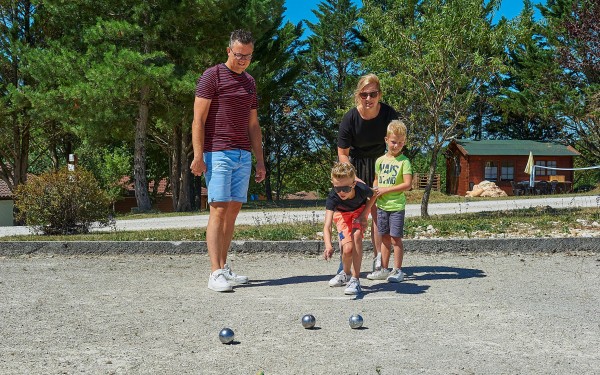
Pétanque is also a firm favourite during a family holiday in the Dordogne. Children pick up the basic rules quickly and often spontaneously join in with other guests at the holiday park.
If you are staying in a holiday in the Dordogne, there is a good chance that the park or a nearby village will have a pétanque court.

The region is also renowned for its beautiful villages and river landscapes. During a tour of the 14 most beautiful villages of the Dordogne you will regularly come across small pétanque courts right in the middle of historic centres. The combination of nature, tranquillity and culture makes the Dordogne valley in France one of the finest regions in which to experience the authentic French pétanque atmosphere. 

Pétanque in the Languedoc

Pétanque is also a firm favourite during a holiday in the Languedoc pétanque is just as much at home. The region around Pyrenees is known for its historic villages, Mediterranean atmosphere and long summer evenings outdoors. In smaller villages especially, you will see locals gathering on squares beneath the trees or beside cafés, playing for hours on end while others watch from the terrace. If you are staying in a holiday home in this region, you will quickly notice how strongly outdoor life is woven into the local culture.

Many holidaymakers combine an evening of pétanque with a visit to the vibrant markets in the Languedoc or a stroll through historic villages. Around Quillan and the Pyrenees, the emphasis is firmly on peace, nature and village life. Visiting the tourist places you will regularly come across local pétanque courts. The region is popular with families for its combination of sun, nature and relaxation. During a family holiday in the Languedoc pétanque often turns out to be a surprisingly enjoyable activity for all ages.

Jeu de boules in Poitou-Charentes

Although pétanque is strongly associated with the South of France, the game is now played throughout virtually the whole country, including in West of France. During a holiday in Poitou-Charentes you will regularly come across pétanque courts beside village squares or holiday parks. In smaller villages especially, social life still plays out largely outdoors. Staying in a villa in Poitou-Charentes you will discover how relaxed life is here. Atmospheric events, café terraces and jeu de boules all contribute to a typically French holiday atmosphere. The lively local markets draw many visitors who then linger on a terrace while a game of pétanque gets underway on the square. 

Jeu de boules in the French Alps

Pétanque is also played in mountain areas such as the French Alps. During visits to the markets in the French Alps you will regularly see small courts beside cafés or village squares. Even in ski resorts, pétanque remains popular as soon as the snow has gone. In charming mountain villages such as the most beautiful towns in Portes du Soleil a quite different, relaxed summer atmosphere takes hold in which jeu de boules once again becomes part of daily life. 

Pétanque is popular on holiday

Pétanque is one of those activities that fits perfectly with a holiday in France. The game is simple enough for beginners, yet exciting enough to become addictive . That simplicity is precisely what makes pétanque so popular on holiday parks and campsites. All you need is a few balls and a patch of gravel. The holiday parks Domaine de Lanzac Village des Cigales both have pétanque courts.

Pétanque also brings people together. On holiday, spontaneous conversations spring up around the court. Children join in with their parents, neighbours challenge each other to a match and before you know it there is a small crowd watching. Many holidaymakers appreciate precisely that simplicity — no rush, no complicated rules, no packed schedule. Just enjoying the outdoors.

The rules of pétanque explained

Although pétanque looks simple, there are clear rules to follow. 

The aim of the game

The aim is simple: throw your metal balls as close as possible to the jack, closer than your opponent. 

Different formats

There are three main formats:

  • one against one
  • two against two
  • three against three

In three against three, each player usually plays with two balls. In other formats, often with three.

The jack

The small wooden target ball is called the but or cochonnet. At the start of each round, it is thrown to a distance of approximately six to ten metres. 

Throwing from a circle

Players throw from a small circle on the ground. Both feet must remain within this circle until the ball has landed. 

Pointing and shooting

Players attempt to place their ball close to the jack. This is called pointing. A player can also choose to knock an opponent's ball away. This is called shooting. Skilled shooters in particular tend to draw great admiration from the crowd during matches. 

Scoring

After each round, the team scores a point for every ball that lies closer to the jack than the opponent's best ball. A match usually ends when a team reaches thirteen points. Keen players debate sometimes for several minutes over which ball is truly closest to the jack, measuring to within a few millimetres while bystanders lean in curiously as if watching a professional championship final. 

What kind of pétanque balls do players use?

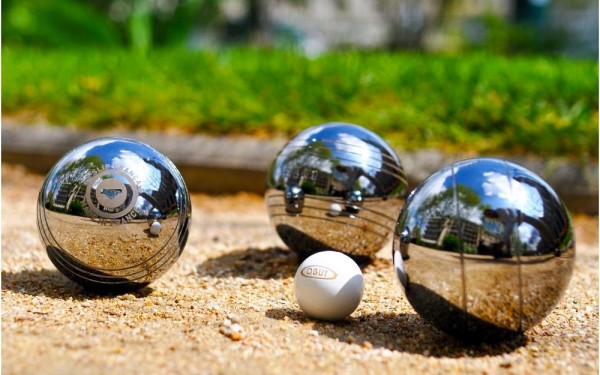
There are various types of pétanque balls. Beginners often choose standard metal boules, while experienced players pay attention to weight, grip and hardness of the steel. Softer boules offer more control but wear faster, while harder boules last longer. For recreational use during a holiday in France, simple standard boules are usually perfectly adequate. 

What is a boulodrome?

An official pétanque court is called a boulodrome . In France there are large professional boulodromes where championships are held, but in practice the French also use the word for simple gravel patches beside a café or on a square. Many holiday parks in France now have their own boulodrome where guests can play.

 The atmosphere at French pétanque tournaments

In summer, many French villages organise local pétanque tournaments . These are often much more than sporting contests. A tournament usually goes hand in hand with music, café terraces, market stalls and long evenings outdoors. Some matches only begin late in the afternoon so that the final is played under atmospheric lighting. For the French, conviviality is often more important than winning.

For tourists, these evenings are often among the most authentic experiences of their holiday in France. Particularly around national holidays such as Quatorze Juillet and other holidays in France large tournaments are often held that draw entire villages out onto the streets.

Petanque 12 jeu de boules Frankrijk vakantie.jpg

Famous pétanque tournaments in France

France hosts major annual pétanque tournaments that bring thousands of players and spectators together. The most famous event is the Mondial La Marseillaise in Marseille, where both amateurs and top players compete. Marseille is regarded as one of the most important cities within French pétanque culture. For more information about the city and events, visit the Tourism office of Marseille.

The Masters de Pétanque international championship also attract many visitors and show how popular the sport remains in France. Internationally, the sport continues to grow in popularity. The official rules and international competitions are overseen by the Fédération Internationale de Pétanque et Jeu Provençal (FIPJP). 

Why pétanque is perfect for a family holiday

Pétanque is surprisingly well suited to families. The rules are simple, so young and old alike can join in quickly. That is why the game fits so perfectly with a family holiday in France. While parents relax on the terrace, children often spontaneously play together on the court. And because the game takes place outdoors, there are no screens, no fuss — just being active together in the fresh air.

Pétanque as part of French outdoor life

In France, a great deal of life takes place outdoors . You notice it on café terraces, at markets and on village squares. Pétanque fits perfectly with that relaxed outdoor lifestyle — which is precisely why jeu de boules remains so popular with both French people and tourists alike.

Pétanque at holiday parks in France

More and more holidaymakers enjoy playing a game of pétanque at their holiday destination. That is why many holiday parks now have their own pétanque court. In the South of France especially, this has become almost standard holiday fare. During the day, families play for fun together, and in the evenings spontaneous mini-tournaments spring up between guests. The simple rules mean almost everyone can take part. During a stay in one of the comfortable holiday home in France you will often notice how quickly people get to know one another around the court.

That social character makes pétanque popular with:

  • families
  • those seeking peace and quiet
  • older visitors
  • groups of friends
  • families with children 

Typical French pétanque terms

During a match you will often hear French terms being used

French term

Meaning

But

Small wooden target ball

Cochonnet

Another name for the jack

Pointer

Placing a ball as close as possible to the jack

Tirer

Knocking an opponent's ball away

Boulodrome

Official pétanque court

Mène

A round within a match

Carreau

Perfect shot where an opponent's ball is hit and your own ball stays in place

Boule

Metal pétanque ball

Pointeur

Player who specialises in placing

Tireur

Player who specialises in shooting

Pied tanqué

“Feet planted on the ground”, origin of the word pétanque

It is those French terms that add to the authentic atmosphere of the game.

The famous “Fanny kiss”

One of the best-known traditions in pétanque is the so-called “Fanny kiss”. If a team loses 13-0, they must symbolically kiss the “Fanny”. Traditionally this involves an image or figurine of a woman whose bottom the losers must kiss. The tradition likely originates from old cafés in the South of France where losers were humorously mocked and had to kiss the waitress's behind. Old Fanny-images still hang on the walls of some village cafés. 

Why pétanque is such a perfect fit for luxury holiday homes

A luxury holiday is not only about comfort, a swimming pool or a beautiful terrace. Many people are looking above all for peace, conviviality and outdoor life. Pétanque fits that perfectly. A relaxed evening on the pétanque court, a drink in hand and views over a South French landscape: for many holidaymakers, that is precisely the feeling France is famous for. This applies across French regions such as the Dordogne-Lot, Gironde, Poitou-Charentes, Provence, Languedoc and the Alpine regions. 

Pétanque and the true feeling of France

Many people think back years later to small moments during their holiday: an evening on a terrace, a market in an old village, a walk through narrow lanes or a spontaneous game of pétanque at sunset. It is precisely those simple moments that make a holiday special. Pétanque therefore belongs not only to France, but to the feeling of being on holiday itself.

Back to the overview